Buying a Mountain View Condo: Ask About Balcony Inspections
Before buying a Mountain View condo, ask for the complete, most recent exterior elevated element inspection report, if the building is subject to that requirement. Then confirm which parts of the project it covers, what repairs it recommends, and whether any access restrictions remain. “The balconies were inspected” is not enough to establish the condition of the balcony or shared walkway you would use.
This is a building-specific review, not a reason to assume every condo has a balcony or every exterior structure falls under the same law. The useful question is whether the documents connect the inspection findings to the actual building, repairs and current conditions.
Which buildings and exterior elements are covered?
California’s condominium inspection law, commonly called SB 326, is found in Civil Code section 5551. The current statute applies only to buildings containing three or more attached multifamily dwelling units. It requires the condominium association to arrange inspections of qualifying exterior elevated elements for which it has maintenance or repair responsibility.
The definition is specific. It covers load-bearing components serving decks, balconies, stairways, walkways and their railings that extend beyond the building’s exterior walls. The walking surface must be more than six feet above ground, designed for human occupancy or use, and supported wholly or substantially by wood or wood-based products. The associated waterproofing systems are also part of the inspection. These include flashings, membranes, coatings and sealants that protect the structural components from water. Read the statutory definitions.
Do not determine applicability from a listing photograph. A finished surface does not establish the supporting material. Ask the HOA and a qualified professional to identify the building configuration, structural materials and governing maintenance responsibilities. If the response is “not applicable,” request the project-specific basis for that answer.
Even a unit without a private balcony may require questions about a shared elevated walkway or stairway. Conversely, an element outside this statute’s definition is not automatically safe or maintenance-free. Keep the legal inspection scope separate from the professional evaluation of a particular structure.
Do not confuse the condo rule with an apartment deadline
As reviewed November 20, 2026, Civil Code section 5551 still states an initial inspection deadline of January 1, 2025, followed by inspections every nine years. Subsection (k) provides separate certificate-of-occupancy-based timing for newer buildings. Ask which provision applies to the particular building rather than deciding from its advertised age.
AB 2579 extended the initial deadline in Health and Safety Code section 17973—the separate law commonly called SB 721—to January 1, 2026. It did not extend Civil Code section 5551’s condo deadline. The current section 17973 excludes common interest developments and contains its own special timing provisions. Renting out an individual condo is not, by itself, a reason to substitute the apartment law for the condominium law.
If someone describes an inspection as “not due yet” or “extended,” ask for the applicable statute and the building records supporting that explanation. Do not import SB 721’s inspection or repair rules into a condo review.
Obtain the actual report, not just an HOA summary
For covered resales, Civil Code section 4525(a)(11) includes the most recent section 5551 inspection report among the documents the seller must provide to a prospective purchaser. Ask your agent to request it through the seller and the association’s document process early enough for meaningful review.
Check that the complete report identifies the correct condominium project and buildings. Request any referenced attachments, location lists, later inspection reports and repair updates needed to understand its findings. A management email saying “inspection complete” is not a substitute for reading the inspector’s findings.
Under section 5551, the inspection must be conducted by a licensed structural or civil engineer or architect. It uses a random, statistically significant sample. That means the law does not necessarily require the inspector to examine every individual balcony during one inspection cycle. Ask whether the element serving your unit was inspected and how the sample relates to your building.
The current statute requires a stamped or signed report addressing physical condition, immediate safety threats, expected future performance, remaining useful life and recommended repairs or replacement. It also specifies first-page information about the inspection date, project and inspection counts, immediate-threat findings and sample certification. For an older report with a different format, ask the inspector or qualified counsel how it relates to the requirements in effect when prepared; do not declare it invalid solely because its layout differs from today’s statute. Current report requirements.
Trace each material finding to its current status
Start with the report’s identified locations. Ask the HOA to connect each material finding affecting your building, balcony or access route to a repair plan or completion record. “Work was done somewhere in the complex” does not answer whether the reported condition you are investigating was addressed.
Next, distinguish recommended work, approved work, work under contract and completed work. Request the relevant scope of work and any available follow-up evaluation. Ask the inspector whether additional investigation was recommended and whether it occurred. Section 5551 allows further inspection when observed conditions indicate water intrusion that could damage load-bearing components, with the inspector determining the necessary scope. Inspection and repair recommendations.
Then check City records where permits or local approval are applicable. Confirm that the address is within City of Mountain View jurisdiction. Request permit numbers, approved repair plans and final inspection or approval records for the relevant work, and ask Building staff to clarify missing or ambiguous records. The City’s Permit Center directs Building and Fire Protection permit submissions through ePermitsMV and lists [email protected] and 650-903-6313 for general inquiries. Its building-permit page provides application resources, while its inspection instructions explain scheduling using a permit number or address. An inspection appointment is not proof of a completed approval.
Finally, verify current access restrictions. If a section 5551 inspector identifies an immediate threat to occupants, the association must take preventive measures immediately, including preventing access until repairs have been inspected and approved by the local enforcement agency. Section 5551(g). Do not step onto a restricted balcony or bypass a barrier during a showing. Ask for the applicable approval records before relying on a statement that the area has reopened.
A report, contractor invoice or permit record cannot certify current safety for a buyer. A sampled inspection has a defined scope and date, and conditions may have changed. Unresolved structural questions belong with an appropriately licensed professional; legal compliance questions may require qualified counsel.
Questions to resolve before your purchase decision
Use the documents to obtain specific answers, rather than collecting paperwork without connecting it to the home:
For the HOA: Which reported locations affect this building and the routes I would use? What work, further investigation or access restrictions remain outstanding?
For the inspector: Was this unit’s balcony or relevant shared element inspected? What could not be evaluated, and what follow-up is needed to address the remaining uncertainty?
For the HOA and City, as applicable: Which records show that the recommended repairs were completed, inspected and approved? Are there unresolved notices or conditions?
For the HOA and transaction advisers: Who is responsible for the work under the governing documents, and what approved or proposed repair charges could affect this unit? Which obligations remain unclear?
The last question is about the identified repair project, not a substitute for a general HOA budget review. Section 5551 ties ongoing association maintenance and repair responsibilities to the governing documents. Review those documents alongside the report rather than assuming every exterior expense is allocated the same way. Association responsibilities.
Make the local decision concrete. If outdoor space is important to you, a closed balcony changes how the home meets that need. If you depend on a shared walkway, unresolved restrictions affect the route you plan to use. Discuss missing reports, unfinished work or unclear approvals with your agent and the appropriate specialists before making binding decisions or removing inspection protections; the right response depends on your contract and the actual findings.
Plan a Mountain View purchase around the building facts
Use our Mountain View real estate guide for broader home and location trade-offs, and review The Rise Group’s home-buyer process to organize your search and disclosure review.
Explore Mountain View homes through the general city search, then refine the property type for your condo search. Evaluate each building’s inspection and repair records separately.
For the wider ownership-cost review after you have identified the repair issues, read Downsizing in Sunnyvale? Review Condo HOA Costs. Our Morgan Hill guide to costs beyond the mortgage provides additional budgeting background; it is not an inspection or safety assessment of a Mountain View condo.
Book a buying/moving consultation to discuss your Mountain View purchase priorities, or Request the Buyer’s Guide as you prepare for the buying process.
Caroline Hobbs | The Rise Group. Published November 20, 2026. Official resources reviewed November 20, 2026. General educational information, not legal or engineering advice. Applicability, inspection findings, repair obligations and safety are project-specific; verify them with the HOA, City and appropriately qualified professionals.
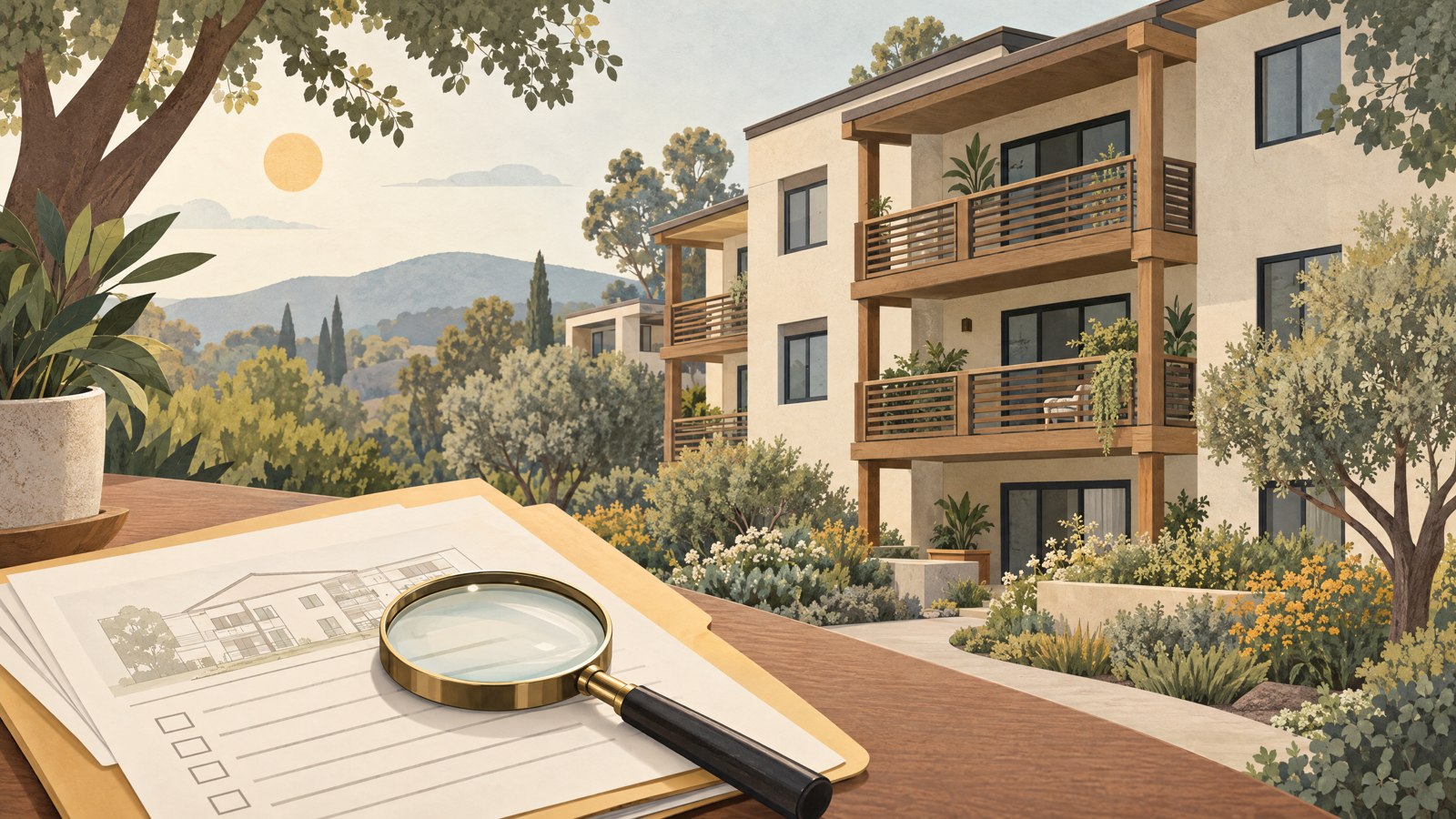
Illustration caption: AI-generated editorial illustration of a fictional condominium exterior; not an actual Mountain View property, inspection or engineering assessment.


