Buying a Gilroy-Area Home with a Well: What to Verify
Before buying a Gilroy-area home advertised with a well, verify the actual water source in writing. Then evaluate water quality, well production and equipment condition separately, and clarify any shared access and ongoing responsibilities. A recent lab report is useful evidence, but it does not establish how much water the well can produce or what repairs the system may need.
Confirm what supplies the home—not just what is on the parcel
A Gilroy mailing address does not establish City jurisdiction or City water service. The home may use City water, another district or water provider, a shared system or an individual private source. Ask for the provider’s name, recent bills, service-account information and available system documents. Confirm service for the exact address with the provider, and identify which source supplies household taps versus irrigation or other uses.
Gilroy’s municipal system includes City-operated wells, pumps, reservoirs and distribution infrastructure. Receiving groundwater through City water service is not the same as owning and maintaining a private well. The City’s annual water-quality report describes its community supply; it does not verify a separate private or shared well. Use the City’s water and utility-service resources when that service actually applies. 1
For an individual or shared source, identify the owner and operator and ask County Environmental Health which program applies. Its Drinking Water Program reviews new and modified individual and shared systems and separately oversees state small water systems. Do not assume all arrangements have the same testing, operating or clearance requirements—or that an existing-home sale automatically requires a development-project clearance. 3
Request the well records and reconcile them with the property
Ask the seller for the well completion report, also called the driller’s log, along with available permits, inspection records, pump-test results and maintenance history. Include water-quality reports, treatment-equipment information and a map of the well and distribution lines. Valley Water’s private-well guide recommends retaining construction, pump-test, distribution and maintenance records because they help explain the system and troubleshoot changes. 5
Use Valley Water’s Well Information App as a starting point, not a definitive property survey. Valley Water says mapped locations are approximate and records can be missing or inaccurate. A blank search does not prove there is no well; a mapped point does not establish a boundary or easement. Its page directs users to California’s Department of Water Resources for well completion reports. Ask Valley Water and County Environmental Health how to obtain available records for the particular well. 4
Have a qualified well professional compare the records with the installed system. Resolve discrepancies such as an unidentified well, undocumented changes or a report that may describe a different source. Old construction records are background, not proof of present condition or future performance.
Obtain recent water-quality evidence with the right scope
Arrange sampling with a state-certified drinking-water laboratory or qualified sampling professional. Ask the lab to confirm its current certification for the requested analyses and explain collection locations, containers and handling. County Environmental Health can help identify parcel-specific concerns and interpret what follow-up is needed. 6
A report should identify the sample date and location, substances tested, results and units. Ask whether the sample represents untreated well water or water after treatment at a household tap. Have the lab or appropriate professional explain what the results establish and what they leave unanswered. A result for one contaminant is not a result for contaminants that were never tested.
EPA and CDC recommend annual private-well testing for total coliform bacteria, nitrates, total dissolved solids and pH, with additional testing based on local concerns. Valley Water recommends annual coliform, nitrate and electrical-conductivity testing for domestic wells. These are guidance recommendations, not a verified universal minimum for a Gilroy-area purchase. Let the laboratory and County Environmental Health help select the appropriate panel for the source, nearby activities and intended use. 6 8
Clear-looking water is not a safety guarantee, and neither is a single acceptable report. Testing addresses the collected sample and tested substances, not every possible contaminant or future condition. EPA and CDC also recommend testing after well-system repairs, flooding or relevant nearby disturbances, and changes in taste, color or smell. Ask how recent events affect the usefulness of the seller’s report. If a result raises a concern, seek professional interpretation and a documented follow-up plan rather than assuming a filter solves it. 6
Evaluate well production and equipment separately
Water-quality testing asks what is in the sampled water. A production or yield evaluation asks how much water the well can supply under the test conditions. Valley Water’s guide identifies pump-test data as evidence of production and a tool for assessing changes as a well ages. 5
Hire a qualified well or pump professional to recommend a suitable inspection and production test for this property. Ask the written report to explain the test method and duration, pumping rate, water-level changes and recovery where measured, equipment used, and limitations. Discuss your expected household and irrigation demand. A strong flow at one faucet—or water supplied from a storage tank—is not a substitute for a well-production evaluation.
Ask the professional to evaluate accessible wellhead protection, casing and seals, the pump, pressure tank, storage and treatment equipment as applicable. Request service history and written estimates for material issues. Valley Water notes that maintenance and pump problems can affect production and recommends a maintenance schedule tailored to the well and water needs. A test performed now is not a promise of uninterrupted future supply. 5
Verify wastewater disposal separately. A well supplies water; septic handles wastewater. A rural or foothill location does not prove the home has either system. Where septic or other potential contamination sources are nearby, ask the appropriate professionals to evaluate their relationship to the well. EPA identifies septic care and keeping pollutants away from wells as water-protection measures, but a septic inspection does not verify well water, and a water test does not evaluate septic condition. 6
Put shared use and access responsibilities in writing
If another parcel shares the well—or the well or a water line is off the property—request the written water-use agreement and relevant recorded easements. Ask your title team and, where needed, a qualified legal adviser to review ownership, the right to receive water, access for maintenance, and how those arrangements apply after transfer. Do not rely on a neighbor’s verbal assurance or a map alone.
Clarify who operates the system, pays electricity and testing costs, authorizes repairs and replaces major equipment. Ask how bills are divided, who can access the well and pipes, and what happens during an outage, contamination event or disagreement. Request recent operating records, disclosed disputes and known planned expenses. Valley Water specifically recommends distribution maps for shared wells because access to plumbing information matters when properties change hands or repairs are needed. 5
Ask County Environmental Health to confirm the system’s classification and applicable oversight. A shared source should not automatically be treated as either an unregulated household well or a public utility. 3
Check lender requirements and plan for ownership
Ask your lender early what source documentation, water testing, production evidence or shared-system documents it needs for your particular loan. Have it clarify report timing, acceptable providers and any follow-up before you commit to a transaction schedule. A seller’s report or an agency record is not a promise of loan approval.
Build an ownership budget from the actual system. Ask about electricity, sampling, professional service, treatment supplies, storage upkeep and eventual pump or tank replacement. Valley Water says certain well owners have groundwater charges and metering obligations; confirm any reporting, meter or charge requirements for this well rather than assuming well water is free. 9
Keep records and arrange a professional maintenance and testing plan after purchase. Also ask how water access would be handled during a pump failure or power outage. The goal is to understand both routine work and the response to a problem—not just to obtain one report for closing.
Use the broader buying resources without substituting them for well checks
Our Gilroy community guide provides wider context on jurisdiction, services and ownership trade-offs. The Rise Group’s home-buyer process explains how we approach the search and review of property information.
“Selling in Gilroy: Inspect Before Choosing Repairs” explains why inspection scope and specialist follow-up matter. A general home-inspection report is not water-quality verification or a well-production and equipment evaluation unless that specific work was actually included and documented.
“Buying a Home in Morgan Hill: What to Budget Beyond the Mortgage” offers a broader ownership-cost framework. It is not a cost estimate for a Gilroy-area parcel or a quote for well repairs; use system-specific professional estimates.
Explore Gilroy homes through our general area search, which includes broader-area addresses. It is not a well-only filter and does not establish any home’s water source or jurisdiction.
Book a buying/moving consultation to discuss your search and the property questions to organize. You can also Request the Buyer’s Guide.
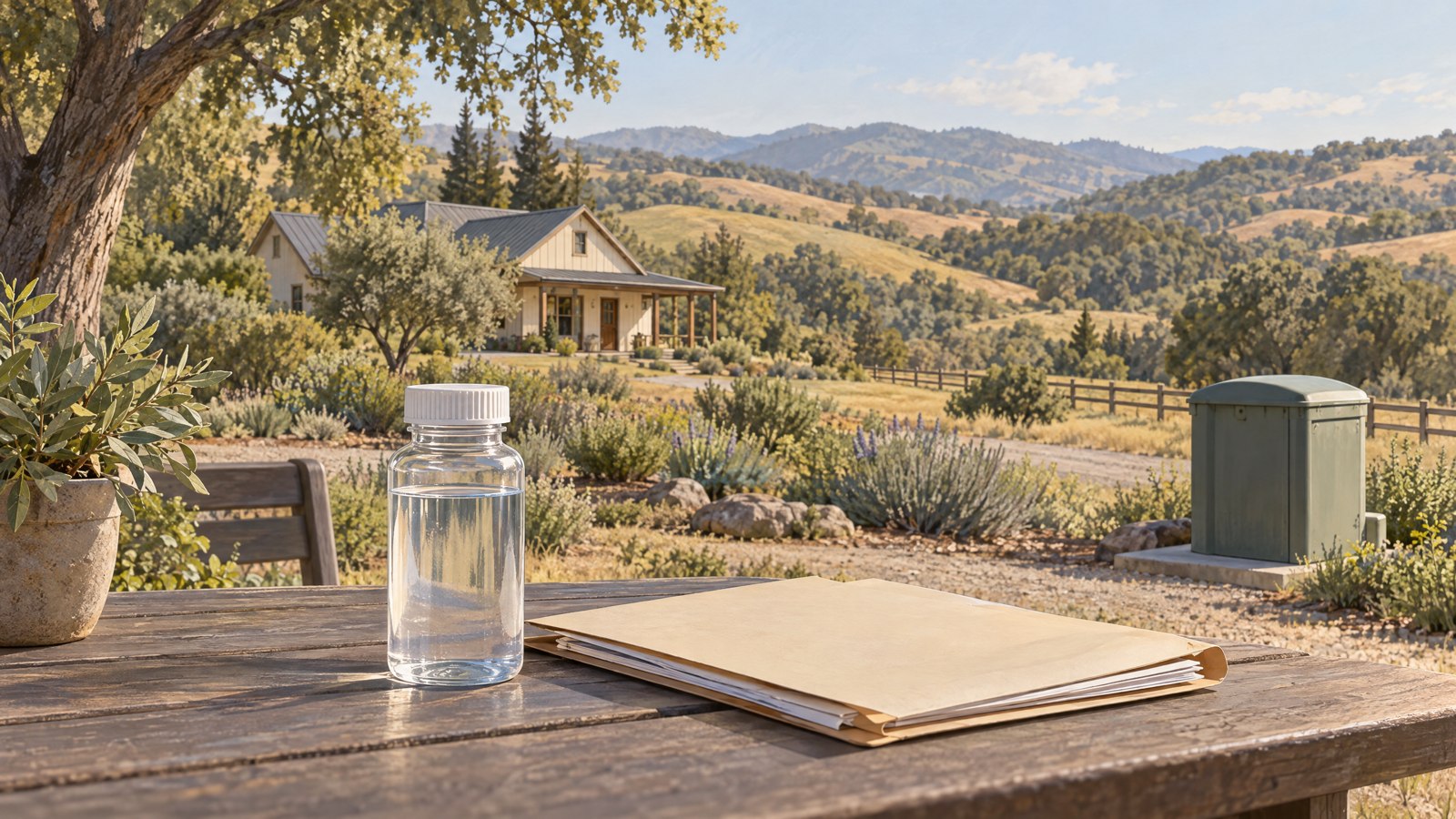
Image caption: Fictional AI-generated editorial illustration; not an actual Gilroy property or a functioning water system.
By Caroline Hobbs | The Rise Group · Published November 21, 2026 · Reviewed November 21, 2026.
General educational information, not individualized engineering, legal, medical or lending advice. Confirm the parcel’s source, documents, sampling, results, well performance and responsibilities with the responsible agencies, laboratory and qualified professionals. No water-safety, future-supply or financing guarantee is provided.
References
1 City of Gilroy — Water
2 City of Gilroy — Utility Services and Billing
3 Santa Clara County DEH — New well construction or water system clearance
4 Valley Water — Well Information App
5 Valley Water — Guide for the Private Well Owner
6 EPA — Protect Your Home’s Water
7 CDC — Guidelines for Testing Well Water
8 Valley Water — Certified Laboratories
9 Valley Water — Wells and Well Owners


